

High-End Video Image Processing Module PCBA
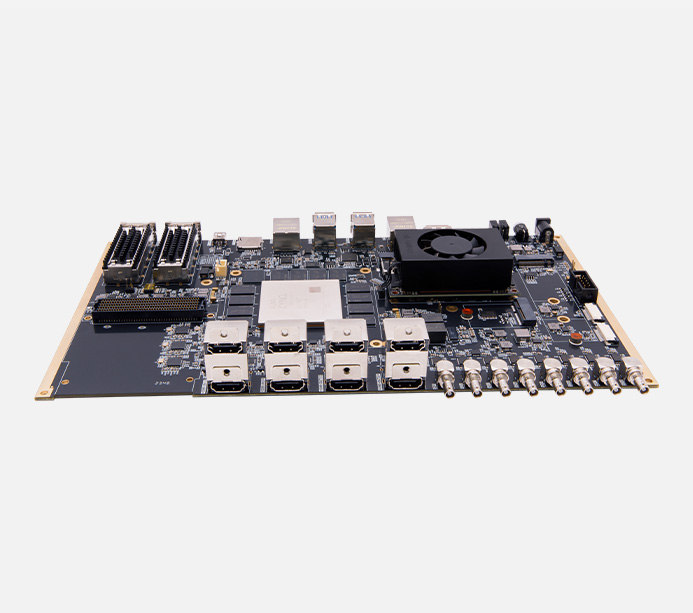
Successful Practice of One-Stop Manufacturing Solution for High-End Video Image Processing Module PCBA
—— Empowering AI and Edge Computing Customers with Engineering Expertise to Overcome Design, Supply Chain and Delivery Challenges
1. Project Overview: Challenges and Achievements
Customer Sector: AI Robotics, Edge Computing
Core Product: High-end Video Image Processing Module PCBA (Core Board + Expansion Board Structure)
Project Challenges:
Extremely High Design Complexity: The core board adopts a 12-layer HDI design, integrating a high-performance processor in LGA package, supporting 8K video processing and high-speed optical fiber transmission, which puts extreme demands on signal integrity, power integrity and heat dissipation.
Supply Chain Risks: Long and unstable lead times for key components have seriously threatened the project progress.
Enormous Delivery Pressure: The end customer's product launch schedule is tight, with extremely high requirements for the overall cycle of PCB production, component procurement and PCBA assembly.
Stringent Quality and Reliability Requirements: Applied in industrial, medical and other fields, the product is required to work stably in the industrial temperature range of -40~85℃, with zero tolerance for the original quality of components.
Core Achievements:
Through our one-stop service from design collaboration to mass production delivery, the overall project delivery cycle has been shortened by more than 30%. Meanwhile, the high performance and reliability of the product are guaranteed through strict process control, winning high praise from the end customer.
2. Customer Needs and Our Value Proposition
The end customer needs a high-reliability module that meets high-speed data transmission, AI edge computing, and professional 8K video acquisition and processing, with rich video interfaces (12G-SDI, DP, HDMI) and high-speed optical fiber interfaces.
Our Value Proposition:
We are not only a manufacturer, but also an engineering partner for the success of your products. We deeply understand the essence of high-speed circuit design, and through the trinity service of "Design for Manufacturability (DFM) Collaboration", "Strategic Supply Chain Management" and "High-Precision Assembly and Testing", we ensure that your complex design solutions can be efficiently and accurately transformed into stable and reliable hardware products.
3. Detailed Explanation of One-Stop Solution
3.1 High-Reliability PCB Manufacturing for High-Speed Applications
Stack-Up Structure and Process
For the "core board + expansion board" structure of the module, we have customized a PCB solution with precise layering and adaptation to high-speed scenarios:
Core Board (12-layer High-Density HDI)
Layer Number | Layer Type | Function Description |
1 | Signal Layer (Top) | Routes processor peripheral IO control signals and Flash configuration signals |
2 | Ground Plane (GND1) | Acts as the reference plane for Layer 1 and Layer 3, covering most areas of the core board |
3 | Signal Layer | Routes high-speed differential signals of board-to-board connectors and DDR address/control signals |
4 | Power Plane (PWR1) | Power supply plane for processor core voltage (VCCINT=1.0V) |
5 | Signal Layer | Routes DDR data single-ended signals and power management chip control signals |
6 | Ground Plane (GND2) | Acts as the reference plane for Layer 5 and Layer 7, covering the DDR area |
7 | Signal Layer | Routes DDR data differential pairs (DQ/DQS) and high-speed clock signals |
8 | Power Plane (PWR2) | Power supply plane for DDR voltage (VCCIO_DDR=1.8V) and processor IO voltage (VCCIO=3.3V) |
9 | Signal Layer | Routes auxiliary function signals (e.g., reset, indicator lights) |
10 | Ground Plane (GND3) | Acts as the reference plane for Layer 9 and Layer 11, shielding the auxiliary signal area |
11 | Signal Layer | Routes power feedback and current detection signals |
12 | Signal Layer (Bottom) | Routes test points and pin connections of peripheral small components |
Adopts FR-4 (TG≥150℃) high-end laminate to ensure industrial temperature range stability, with the following stack-up design:
Expansion Board (8-layer)
Adopts the same specification of FR-4 laminate to meet the needs of interface expansion and power distribution, with the following stack-up design:
Layer Number | Layer Type | Function Description |
1 | Signal Layer (Top) | Routes HDMI interface signals, optical fiber interface control signals and fan power interface signals |
2 | Ground Plane (GND1) | Acts as the reference plane for Layer 1 and Layer 3, covering the HDMI/optical fiber interface area |
3 | Signal Layer | Routes high-speed differential transceiver signals of optical fiber interface (rate ≤6.375Gb/s) |
4 | Power Plane (PWR1) | Power supply plane for expansion board IO voltage (VCCIO=3.3V) and HDMI chip supply voltage |
5 | Signal Layer | Routes HDMI differential signals (HDMI 1.4b standard) and board-to-board connector auxiliary signals |
6 | Ground Plane (GND2) | Acts as the reference plane for Layer 5 and Layer 7, shielding the HDMI differential signal area |
7 | Signal Layer | Routes power management chip output signals and indicator light control signals |
8 | Signal Layer (Bottom) | Routes test points and connections of peripheral resistors and capacitors |
Surface Process
Electroless Nickel Immersion Gold (ENIG) process is adopted for all products, which balances the stability of high-frequency signal transmission (reducing signal loss) and the wear resistance and welding reliability of interfaces, adapting to the long-term use requirements of industrial scenarios.
Key Process Control and Implementation
High-Speed Signal Processing
Precise Impedance Control: Strictly ensure the impedance design requirements of HDMI (TMDS differential pairs) 90Ω±10%, optical fiber interface (high-speed differential pairs) 100Ω±10%, and DDR (single-ended/differential) 50Ω/100Ω;
Equal Length and Shielding Design:
High-speed differential pairs of board-to-board connectors achieve equal length within 10mil and adopt "ground wrap wire" shielding;
The intra-pair length error of DDR differential pairs (DQ/DQS) ≤10mil, and the inter-group error ≤30mil;
The intra-pair length error of HDMI TMDS differential pairs ≤5mil, and the inter-group error ≤15mil, meeting the 8K video timing requirements;
The optical fiber interface differential pairs adopt ground via stitching every 100mil for shielding to suppress electromagnetic interference;
Reference Plane Guarantee: All high-speed signals are equipped with adjacent continuous ground planes to avoid crossing split planes.
Power Integrity Design
Independent Allocation of Multiple Power Layers: Set independent power planes for voltage domains such as processor core, DDR and IO interfaces to avoid crosstalk;
Optimization of High-Current Loops: Adopt 2oz copper thickness and via array (pitch ≤1mm) for high-power consumption areas to reduce voltage drop and thermal resistance.
Thermal Design
Heat Dissipation Enhancement of Core Board: 3oz copper thickness + array thermal pads are used on the bottom layer of the processor area to quickly conduct chip heat;
System-Level Thermal Support: Fan mounting holes are reserved on the expansion board to form a "in-board heat conduction + out-board air cooling" solution, adapting to the temperature range of -40~85℃.
Delivery Breakthrough
The original 45-day PCB production cycle was shortened to 30 days, and all Engineering Queries (EQ) were processed within 5 days through in-depth engineering docking, ensuring the accurate implementation of design intent.
3.2 Strategic Component Supply Chain and Quality Assurance
Core Challenge: The lead time for key components such as core processors is as long as 18 weeks, which is the biggest risk point in the critical path of the project.
Delivery and Quality Breakthroughs:
Lead Time Reduction: With strong supply chain resources, the lead time of key components is shortened from 18 weeks to 12 weeks;
100% Original Guarantee: Provide original Certificate of Conformity (CoC) from the manufacturer for all components to ensure material traceability;
On-Site Material Inspection by Customer: Invite the end customer to conduct on-site material inspection before assembly, receiving a "very satisfied" evaluation and establishing trust from the source.
3.3 Precise PCBA Assembly and Comprehensive Test Verification
Hybrid Assembly Process
Core Board: For LGA package processors and 0402/0201 resistors and capacitors, high-precision solder paste printing + customized reflow soldering profile are adopted, with the soldering yield reaching 99.99%;
Expansion Board: Adopt the hybrid process of "reflow soldering (resistors/capacitors/chips) + selective wave soldering/manual auxiliary soldering (connectors)" to balance efficiency and reliability.
Full-Process Test Strategy
Core Board Testing:
Processor functional test: Verify the correctness of logical functions and configuration;
DDR bandwidth and stability test: Ensure the data throughput performance meets AI computing requirements.
Whole Board System Testing:
HDMI/DP transceiver test: Verify the integrity of 8K video signal input and output;
Optical fiber interface test: Conduct high-speed link bit error rate test;
Power stability test: Simulate full-load operation and test ripple and dynamic response.
Delivery Guarantee
After the materials are all in stock, the whole process from SMT to system testing is completed within 1 month, ensuring the product launch schedule